English
  français
  Deutsch
  русский
  español
  português
  العربية
  Melayu
  ไทย
ไทย  Indonesia
  हिंदी
हिंदी 


How to Ensure Your Aluminum Profile Manufacturer Meets Industry Standards
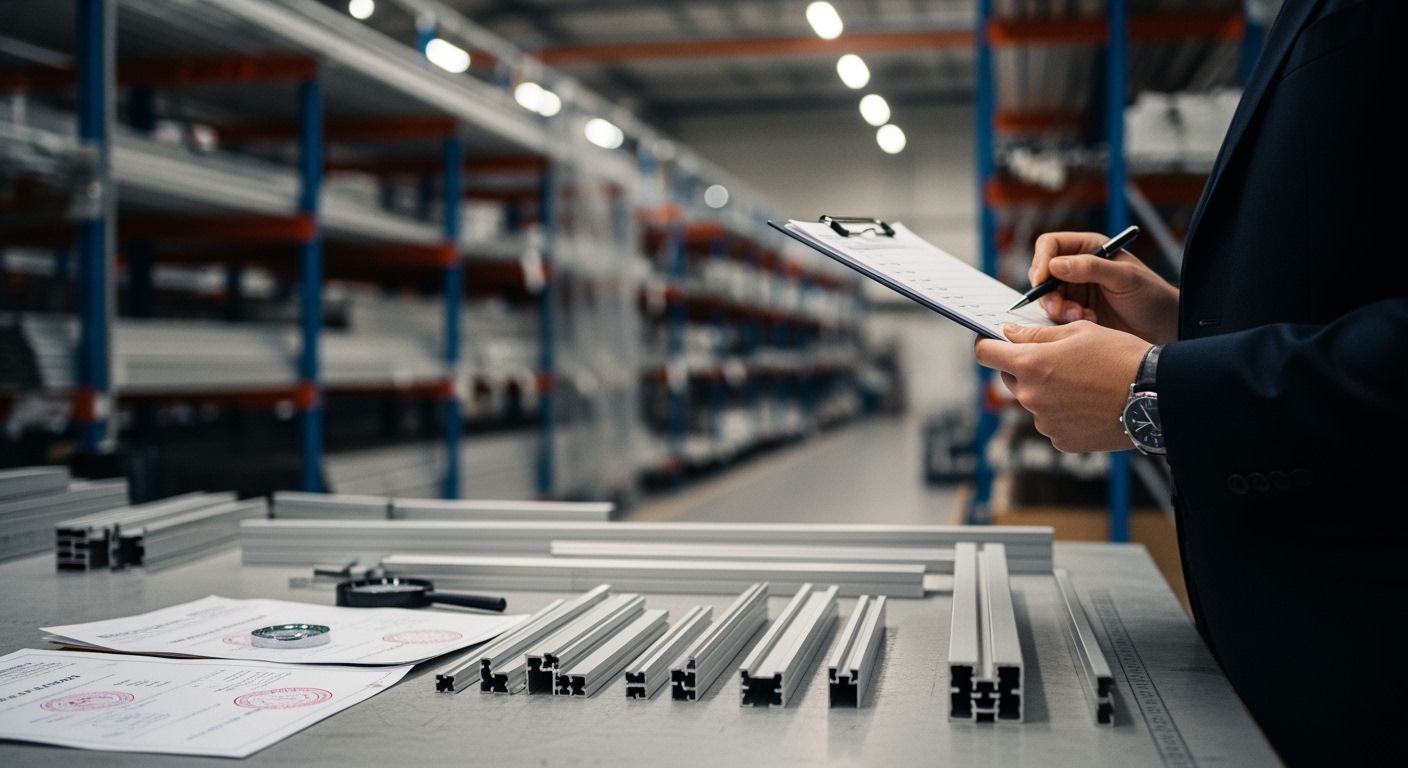
You need to verify that your aluminum profile manufacturer follows strict standards to ensure consistent quality and reliable performance. Quality in aluminum profiles depends on evaluating material composition, inspecting surface finish, and checking structural integrity. Manufacturers who follow industry standards use effective inspection techniques and practical quality assurance tips. This dedication to quality leads to high-quality aluminum profiles, improved durability, and greater safety for your projects. Reliable manufacturers show a commitment to client satisfaction and precision.
Key Takeaways
-
Verify ISO 9001 certification for your aluminum profile manufacturer. This certification ensures they follow strict quality management standards.
-
Request compliance documentation, such as Mill Test Reports and Inspection Reports. These documents confirm the quality and specifications of the aluminum profiles.
-
Evaluate the manufacturer's quality control protocols. Look for multi-stage inspections and material traceability to ensure consistent quality.
-
Assess the manufacturer's reputation through client testimonials and industry references. A strong reputation indicates reliability and quality.
-
Consider customization options and engineering capabilities. Tailored solutions improve functionality and meet specific project needs.
ISO Certifications and Industry Standards
Importance of ISO for Aluminum Profile Manufacturers
You need to check if your aluminum profile manufacturer holds valid certifications. ISO certifications play a critical role in establishing quality standards for the industry. ISO 9001 stands out as the most recognized certification for aluminum profile manufacturers. This certification demonstrates a commitment to ongoing quality assurance and consistent production processes. When you select a manufacturer with ISO 9001, you gain confidence in their ability to deliver high-quality aluminum profiles.
Tip: Always ask your custom aluminum extrusions supplier for their ISO 9001 certification. This step helps you verify their dedication to quality standards.
The following table highlights the most widely recognized ISO certifications relevant to aluminum profile manufacturers:
|
Certification |
Description |
|---|---|
|
ISO 9001 |
Specifies requirements for a quality management system, allowing manufacturers to demonstrate their ability to provide quality products consistently. |
ISO 9001 certification benefits you in several ways. It ensures uniformity in product quality, engages manufacturers in customer feedback, and reduces defects. Companies with ISO 9001 report up to 25% fewer defects in the first year after certification. Waste minimization and improved efficiency also result from this certification. Trust and credibility increase when you see ISO certifications, making it easier to choose a reliable OEM aluminum extrusion manufacturer.
|
Benefit |
Description |
Impact on Quality Assurance |
|---|---|---|
|
Consistent Quality |
Ensures uniformity in product quality through standardized processes. |
Reduces variability in products. |
|
Customer Satisfaction |
Engages with customers to gather feedback and improve services. |
Enhances product quality based on feedback. |
|
Defect Reduction |
Companies report up to 25% fewer defects in the first year post-certification. |
Directly improves product reliability. |
|
Waste Minimization |
Focuses on preventing mistakes and reducing waste throughout production. |
Leads to higher efficiency and lower costs. |
|
Trust and Credibility |
Certification signals adherence to strict quality standards. |
Builds confidence among buyers and partners. |
GUANGYA ALUMINUM serves as a strong example. This aluminum profile manufacturer holds ISO 9001 certification and follows strict quality standards. You can rely on their certifications to ensure your project receives high-quality aluminum profiles.
Key Industry Standards (ASTM B221, etc.)
You must understand the standards that govern aluminum profile manufacturing. ASTM B221 is the primary standard for extruded aluminum profiles. This standard covers chemical composition, mechanical properties, dimensional tolerances, and quality assurance. It also sets requirements for identification and marking, ensuring traceability.
|
Requirement |
Description |
|---|---|
|
Chemical composition |
Specifies limits for various aluminum alloys as per Table 1. |
|
Mechanical properties |
Defines tensile properties for different alloys and tempers as per Table 2. |
|
Dimensional tolerances |
Details permissible variations according to ANSI H35.2M. |
|
Quality assurance |
Outlines sampling, testing, and inspection requirements. |
|
Identification and marking |
Sets traceability requirements per ASTM B666/B666M. |
Besides ASTM B221, you should look for other international standards. European Standards (EN 2635), British Standards (BS L168), and Chinese Standards (GB/T 6892) are commonly referenced. These standards ensure that your aluminum profile manufacturer meets global quality standards.
|
Standard Type |
Standard Code |
Description |
|---|---|---|
|
European Standards |
EN 2635 |
Aerospace series - Aluminium alloy AlCu6Mn - Wrought - Solution heat treated, stress relieved by compression and precipitation treated |
|
British Standards |
BS L168 |
Aluminium alloy bar, extruded round tube and sections (Cu6Mn) - Largely replaced by EN standards in UK |
|
Chinese Standards |
GB/T 6892 |
Chinese national standard for extruded aluminum products |
Note: When you work with a certified aluminum profile manufacturer, you ensure compliance with both local and international quality standards.
Verifying Compliance Documentation
You need to request proper documentation to verify adherence to industry standards. Reliable manufacturers provide certifications and compliance documents that confirm their commitment to quality standards. The following table lists the types of documentation you should ask for:
|
Document Type |
Purpose |
Issued By |
|---|---|---|
|
Mill Test Report (MTR) |
Confirms alloy composition and properties |
Manufacturer |
|
Dimensional Inspection Report |
Verifies profile size and tolerance |
Quality department |
|
Surface Inspection Report |
Confirms surface finish quality |
Inspection team |
|
Certificate of Conformity |
Declares product meets contract specs |
Manufacturer |
Third-party audits and certifications further strengthen compliance. Material certification verification is crucial for quality management systems like ISO 9001. Proper documentation control and record retention support both internal and third-party audits. Accurate material records help manufacturers demonstrate compliance and respond efficiently to audit requests.
Always review the certifications and compliance documentation before finalizing your supplier. This step protects your project and ensures you receive high-quality aluminum profiles.
If you choose GUANGYA ALUMINUM, you gain access to comprehensive certifications and compliance documentation. This aluminum profile manufacturer maintains strict quality standards and supports third-party audits. You can trust their certifications to meet industry standards and deliver reliable products.
Quality Assurance for Aluminum Profile Manufacturers
Quality Control Protocols
You need to evaluate the quality control protocols your aluminum profile manufacturer uses. Robust quality control processes ensure that every profile meets strict standards and material standards. A comprehensive quality assessment starts with material traceability. You should confirm that the manufacturer tracks aluminum from billet to finished extrusion profile. This step guarantees that the material standards are consistent and reliable.
Quality control protocols also include multi-stage dimensional inspections. These inspections occur throughout the production process, not just at the final stage. Surface quality monitoring happens before and after finishing operations. Documented process parameters allow repeat and long-term orders to maintain the same quality and assurance. You gain confidence in the accuracy and dimensional accuracy of your profiles when you see these protocols in action.
-
Material traceability from billet to finished profile
-
Multi-stage dimensional inspections during production
-
Surface quality monitoring before and after finishing
-
Documented process parameters for repeat orders
Regular inspections form the backbone of quality assurance. You should expect your custom aluminum extrusions supplier to perform regular inspections at every stage. These inspections help identify defects early and maintain high-quality aluminum profiles. GUANGYA ALUMINUM sets a benchmark in quality control. Their protocols ensure accuracy, assurance, and consistent quality for every order.
Inspection of High-Quality Aluminum Profiles
You must understand the inspection methods that identify defects in high-quality aluminum profiles. Advanced inspection models help manufacturers detect surface imperfections and maintain dimensional accuracy. The following table shows several effective inspection models and their features:
|
Model Name |
Key Features |
Challenges in Detection |
|---|---|---|
|
YOLOv11 |
Fast and efficient performance for defect detection |
Difficulty in detecting small, blurry defects |
|
LAD-YOLO |
Lightweight variant reducing computational load |
Challenges with small targets in complex backgrounds |
|
MA-YOLO |
Attention-guided model improving detection performance |
Small target detection remains a challenge |
|
CW-YOLOv5 |
Multi-scale semantic enhancement for better detection results |
High complexity and large number of parameters |
|
YOLOv8-ARL |
Improved performance with new modules |
Further optimization needed for specific defects |
|
Enhanced YOLOv5s |
Incorporates attention mechanisms for speed improvement |
Struggles with complex backgrounds and small defects |
You should ask your OEM aluminum extrusion manufacturer about their inspection technology. High-quality aluminum profiles require advanced inspection systems to ensure accuracy and assurance. Regular inspections using these models help maintain quality and reduce defects. Comprehensive quality assessment depends on reliable inspection methods and regular inspections.
Tip: Request detailed inspection reports from your aluminum profile manufacturer. These reports should include surface and dimensional checks, defect detection, and process parameters.
GUANGYA ALUMINUM uses advanced inspection systems and regular inspections to deliver high-quality aluminum profiles. Their quality control protocols ensure accuracy and assurance for every project.
Surface and Dimensional Checks
You need to check for surface imperfections and verify extrusion tolerances. Surface checks identify scratches, dents, and other defects that affect quality. Dimensional checks confirm that profiles meet material standards and dimensional accuracy requirements. These checks form part of a comprehensive quality assessment.
Extrusion tolerances impact fit, assembly, and functional performance. Tighter tolerances ensure that parts fit together and function as intended. The following table explains how extrusion tolerances affect performance and application:
|
Impact Area |
Description |
|---|---|
|
Fit and Assembly |
Tighter tolerances are essential for dimensions that affect how well parts fit together and function. |
|
Functional Performance |
Critical dimensions require tighter tolerances to ensure optimal performance of the final product. |
|
Manufacturing Efficiency |
The choice of tolerances influences the efficiency of the manufacturing process and associated costs. |
|
Tooling Complexity |
Tighter tolerances can increase the complexity of tooling and production processes. |
|
Inspection and Machining Needs |
More stringent tolerances may lead to increased inspection frequency and additional machining work. |
|
Cost Implications |
The overall cost of the project can be affected by the tolerance strategy employed. |
You should expect your aluminum profile manufacturer to perform regular inspections for surface and dimensional accuracy. These inspections ensure that profiles meet material standards and quality requirements. Comprehensive quality assessment includes surface checks, dimensional checks, and regular inspections.
Note: GUANGYA ALUMINUM’s quality management sets a benchmark for the industry. Their quality control protocols, regular inspections, and comprehensive quality assessment ensure high-quality aluminum profiles with consistent accuracy and assurance.
Material and Performance Standards
Chemical Composition and Mechanical Properties
You must pay close attention to the chemical composition and mechanical properties when selecting aluminum profiles. Different alloy grades offer unique combinations of strength, resistance, and quality. For example, 6063 aluminum alloy contains 0.45-0.9% magnesium and 0.2-0.6% silicon, which makes it ideal for applications that require excellent extrudability and surface finish. In contrast, 6061 aluminum alloy, with 0.8-1.2% magnesium and 0.4-0.8% silicon, provides higher strength and improved machinability for structural uses.
6063 aluminum has a chemical composition of 0.45-0.9% magnesium and 0.2-0.6% silicon, while 6061 aluminum contains 0.8-1.2% magnesium and 0.4-0.8% silicon.
You should always consider both yield strength and tensile strength. Yield strength marks the point where aluminum starts to deform permanently. Tensile strength is the maximum stress the material can handle before breaking. These properties ensure that your profiles can withstand operational loads and maintain their shape and function. This balance is essential for strength and durability testing, especially in demanding environments.
Corrosion Resistance and Surface Finish
Corrosion resistance plays a critical role in the long-term performance of aluminum profiles. You should request a test for corrosion resistance, such as the Salt Spray Test (SST), from your custom aluminum extrusions supplier. This test exposes profiles to a salt spray environment and measures the time until corrosion appears. High resistance to corrosion ensures that profiles last longer, even in harsh conditions.
Surface finish quality also impacts both resistance and appearance. The right finish increases resistance to wear and environmental factors. It also enhances the profile’s durability and visual appeal. A poor surface finish can reduce resistance and shorten the lifespan of your profiles. You should choose finishes that provide both functional and aesthetic benefits, ensuring protection against corrosion and environmental damage.
-
The selected finish directly affects durability and corrosion resistance.
-
Choosing the right finish is crucial for protection against wear and corrosion.
-
Finishes not only improve appearance but also offer essential protection against environmental damage.
Ensuring Consistent High-Quality Aluminum Profiles
You need to verify that your OEM aluminum extrusion manufacturer follows strict standards for quality and consistency. Leading manufacturers use a series of checks and tests to guarantee high-quality aluminum profiles across every batch. These steps include incoming billet inspection, pre-extrusion setup, real-time monitoring during extrusion, post-quench inspection, and final documentation review.
|
Quality Check Type |
Purpose |
Importance Level |
|---|---|---|
|
ISO 9001 Certification |
Confirms standardized process control |
High |
|
Dimensional Checks (CMM) |
Verifies complex geometry and tolerances |
High |
|
Material Composition Test |
Ensures correct alloy grade and properties |
High |
|
Visual Inspection |
Catches surface defects and finish issues |
Medium |
You should expect your supplier to conduct strength and durability testing, test for corrosion resistance, and monitor defect rates. They must link each batch to its alloy, temper, and process parameters. Regular audits and reviews help maintain quality and resistance over time. This approach ensures that you receive profiles with consistent strength, resistance, and quality for every project.
Manufacturer Reputation and Support
Experience and Customer References
You should always assess the reputation of an aluminum profile manufacturer before making a decision. A strong reputation signals consistent quality and reliability. You can evaluate supplier reputation by reviewing industry references and client testimonials. These sources provide real feedback from buyers and reveal how the manufacturer handles quality and service. Consistent positive feedback demonstrates a solid reputation in the industry.
-
Industry references offer insights into manufacturer reputation.
-
Client testimonials reflect real experiences with quality and service.
-
Consistent positive feedback signals a trustworthy manufacturer.
You should also consider supplier experience. Manufacturers with extensive experience often have a proven track record for quality and reliability. You can ask for customer references to confirm supplier experience and reputation. This step helps you avoid risks and ensures you choose reputable suppliers for your project.
Customization and Engineering Capabilities
You need to evaluate the customization and engineering capabilities of your aluminum profile manufacturer. Top manufacturers invest in advanced technology and research to improve production processes. They offer extensive customization options, allowing you to receive tailored solutions for your application. Strict quality control measures ensure that every custom order meets your specifications.
Advanced engineering services add value to your project. Customization services let you design profiles for specific needs, improving functionality and efficiency. Precision cutting services guarantee clean, accurate cuts, which reduce assembly errors. Special finishes, such as color anodizing and powder coating, enhance durability and meet environmental requirements. You should expect your custom aluminum extrusions supplier to provide these engineering capabilities for the best results.
Delivery Reliability and After-Sales Service
You must consider delivery reliability when selecting a manufacturer. Reliable delivery ensures your project stays on schedule and avoids costly delays. Reputable suppliers maintain strong logistics and communication to meet deadlines.
After-sales service reflects the commitment of a manufacturer to long-term customer satisfaction. You should look for manufacturers who offer comprehensive support after delivery. The table below highlights common after-sales services provided by reputable suppliers:
|
After-Sales Service Type |
Description |
|---|---|
|
Quality Problem Resolution |
Contact the manufacturer for returns or replacements if there are quality issues. |
|
Online Technical Support |
Receive online assistance for product-related issues during usage. |
You should choose an OEM aluminum extrusion manufacturer that provides reliable delivery and strong after-sales support. This approach ensures you receive high-quality products and ongoing assistance throughout your project.
You can ensure your aluminum profile manufacturer meets industry standards by following a systematic checklist:
-
Review material standards and certifications like ISO 9001.
-
Assess customization options and engineering capabilities.
-
Evaluate supplier experience and reputation.
-
Confirm logistical reliability and after-sales support.
|
Criteria |
Description |
|---|---|
|
Material Standards |
Select strong, durable alloys for performance. |
|
Quality Control |
Choose certified suppliers for consistent quality. |
|
Customization |
Look for flexible design solutions. |
|
Experience |
Trust proven manufacturers. |
|
Logistics |
Ensure reliable delivery schedules. |
Partnering with a trusted OEM aluminum extrusion manufacturer such as GUANGYA ALUMINUM reduces risks and improves product quality. Apply these guidelines before choosing your custom aluminum extrusions supplier for long-term project success.
FAQ
What certifications should you look for in an aluminum profile manufacturer?
You should check for ISO 9001 certification. This certification proves the manufacturer follows strict quality management standards. Reliable OEM aluminum extrusion manufacturers also provide compliance documents for ASTM B221 and other relevant standards.
How can you verify the quality of aluminum profiles?
Ask your custom aluminum extrusions supplier for inspection reports. These reports show surface checks, dimensional accuracy, and material composition. You gain confidence in the quality when you review these documents.
Why is material traceability important?
Material traceability ensures you receive consistent quality. You can track aluminum from billet to finished profile. This process helps you confirm that your OEM aluminum extrusion manufacturer meets industry standards.
What should you expect from after-sales service?
You should expect prompt support for quality issues. Reliable suppliers offer online technical assistance and resolve problems quickly. Strong after-sales service shows the manufacturer’s commitment to your satisfaction.
How do customization options benefit your project?
Customization lets you design profiles for specific needs. Your custom aluminum extrusions supplier can provide tailored solutions, advanced engineering, and special finishes. These options improve functionality and durability for your application.
 Rangkaian IPv6 disokong